
Malacañang has issued a directive prohibiting high-ranking Philippine government officials from traveling to Taiwan, engaging in official transactions with the island nation, or receiving Taiwanese visitors without proper authorization.
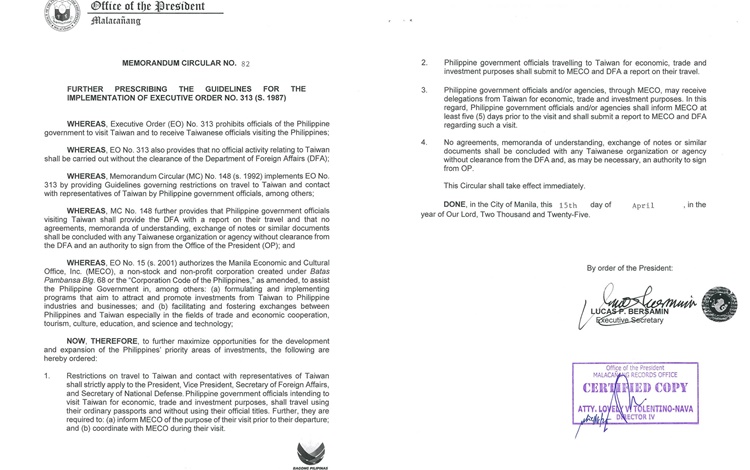
The order is formalized under Memorandum Circular No. 82, series of 2025, released by the Office of the President. The circular outlines strict updated guidelines governing all official interactions with Taiwan, reinforcing the country’s One China Policy amid heightened regional tensions.
The memorandum specifically bars the President, Vice President, Secretary of Foreign Affairs, and Secretary of National Defense from undertaking any form of travel or transaction with Taiwan. Furthermore, it forbids the signing of memoranda of agreement (MOA) or memoranda of understanding (MOU), as well as the exchange of documents with any Taiwanese organization—unless prior approval is secured from both the Department of Foreign Affairs (DFA) and the Office of the President.
In addition to the travel ban, the circular mandates that any Philippine official intending to travel to Taiwan for any purpose must first seek clearance and submit a post-visit report to the DFA and the Manila Economic and Cultural Office (MECO), the Philippines’ de facto embassy in Taiwan.
The circular is seen as part of the government’s efforts to align its foreign relations policy more closely with Beijing, which regards Taiwan as a breakaway province. China has been critical of countries and foreign officials that conduct official engagements with Taiwan, viewing such acts as violations of the One China principle.
While unofficial and cultural exchanges between Taiwan and the Philippines continue through MECO, the new directive aims to tighten control over any high-level interactions that may be construed as diplomatic recognition of Taiwan.
Foreign policy experts noted that this move could have implications on the Philippines’ economic and people-to-people ties with Taiwan, where over 150,000 Filipino workers are currently employed.
As of writing, the DFA has not issued any additional guidance to clarify the implementation of the memorandum, and no statement has yet been released by Taiwanese representatives.
The memorandum is expected to take effect immediately and is binding on all government departments, agencies, and instrumentalities.