
A magnitude 5.0 earthquake struck off the coast of Cabangan, Zambales, on Saturday evening, October 11, according to the Philippine Institute of Volcanology and Seismology (Phivolcs).
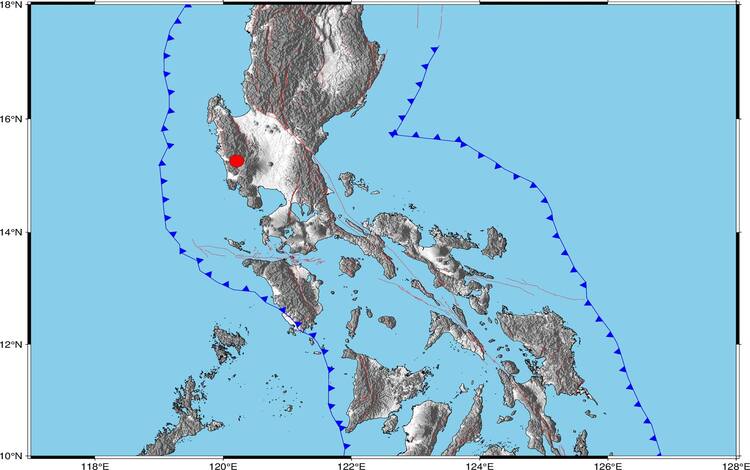
In its official advisory, Phivolcs reported that the tectonic quake occurred at 5:32 p.m., with its epicenter located 19 kilometers northeast of Cabangan, Zambales. The tremor originated at a depth of 100 kilometers, indicating that it was relatively deep and less likely to cause significant surface damage.
Phivolcs confirmed that the quake was tectonic in origin, meaning it was caused by movements in the Earth’s crust — a common occurrence in the seismically active Philippine archipelago, which lies along the Pacific “Ring of Fire.”
The agency recorded instrumental intensities across several provinces in Central and Northern Luzon. “Instrumental Intensity III was recorded in Cabangan and Iba, Zambales,” Phivolcs said. This level of intensity is typically felt indoors, especially on upper floors of buildings, but generally causes no damage.
Meanwhile, Instrumental Intensity II — classified as “slightly felt” — was reported in Calumpit, Bulacan; San Fernando, La Union; Guimba, Nueva Ecija; Bani and Dagupan City, Pangasinan; Santa Ignacia, Tarlac City, and Ramos, Tarlac; as well as Botolan, Subic, and San Marcelino, Zambales.
Phivolcs clarified that no damage to structures is expected, given the earthquake’s depth and moderate strength. However, it cautioned that aftershocks are possible in the hours or days following the main tremor.
Authorities urged residents in affected areas to remain calm but alert for possible ground shaking that may follow. Local disaster risk reduction offices have been advised to monitor reports and ensure that communities remain informed of any new developments.
The Philippines experiences frequent earthquakes due to its location along multiple active faults and trenches. While most are weak and cause little to no damage, Phivolcs continues to remind the public to be prepared for stronger quakes by securing heavy objects, knowing safe spots indoors, and participating in regular earthquake drills.
As of this report, Phivolcs has not issued a tsunami warning or any further advisory related to the Zambales earthquake.