
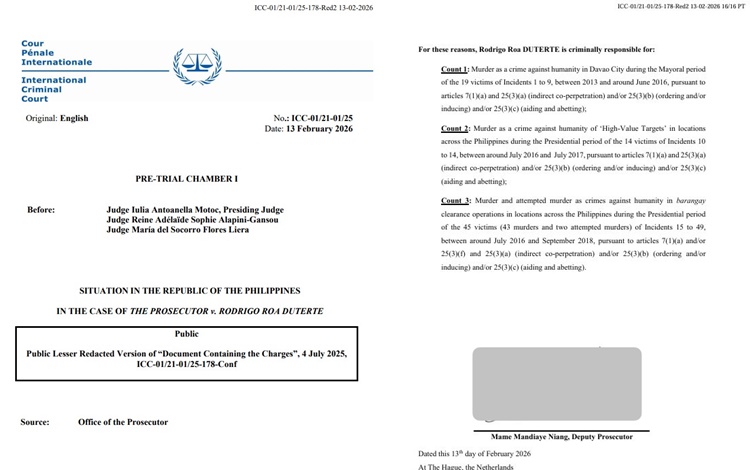
The International Criminal Court has formally released a 16-page “Document Containing the Charges” outlining allegations of crimes against humanity connected to former Philippine president Rodrigo Duterte’s anti-drug campaign. The report presents detailed accusations that the controversial war on drugs followed what prosecutors describe as a coordinated and long-running “common plan” targeting suspected drug offenders between 2011 and 2019.
According to the prosecution, the alleged operations were carried out through two primary enforcement groups. The first is the Davao Death Squad (DDS), which prosecutors claim operated during Duterte’s tenure as mayor of Davao City. The second group, described as a “National Network,” allegedly expanded the same methods nationwide after Duterte assumed the presidency in 2016. Prosecutors argue that this expansion marked a significant shift, transforming localized operations into a broader nationwide strategy.
The document lists three major counts of murder linked to the alleged campaign. The first count focuses on incidents in Davao City between 2013 and 2016, where 19 victims were reportedly killed. The second count centers on operations conducted between 2016 and 2017 that targeted individuals labeled as high-value suspects. These killings allegedly involved financial incentives, including rewards reportedly reaching P1 million per operation.
The third and largest count covers barangay-level operations conducted from 2016 to 2018. Prosecutors allege that these operations resulted in the deaths of 43 individuals and two attempted murders. The report further claims that among the victims were three minors, raising additional concerns about the scope and impact of the alleged campaign.
The prosecution document also names several individuals as alleged co-perpetrators, including Senator Ronald dela Rosa and Senator Bong Go, along with multiple former chiefs of the Philippine National Police. The report claims that Duterte played a central role in designing and implementing the policy, allegedly authorizing the use of hired gunmen and offering assurances of protection and immunity for those involved in the operations.
Prosecutors emphasize that the killings described in the document were not isolated incidents but part of what they classify as a “widespread and systematic attack” directed against civilians. This classification is a critical legal element in establishing crimes against humanity under international law.
Alongside the charges, prosecutors also submitted a “Second Updated List of Evidence” on the same date. The submission reportedly adds two new pieces of evidence to the case. However, authorities have withheld specific details, citing the need to protect confidential witnesses and maintain security protocols.
The case will now proceed to the next legal phase, where judges will determine whether sufficient evidence exists to move forward to a full trial, a decision that could have significant legal and political implications both domestically and internationally.