
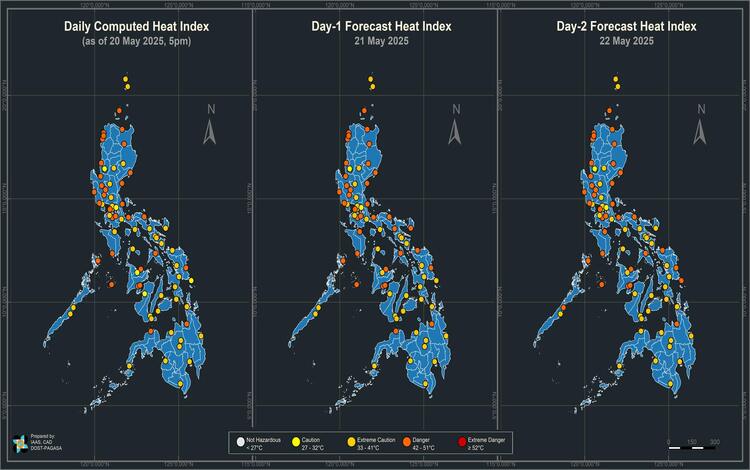
The Philippine Atmospheric, Geophysical and Astronomical Services Administration (PAGASA) has warned that 37 areas across the country are expected to experience a “danger level” heat index ranging from 42°C to 46°C on Wednesday, May 21.

In its 5 p.m. forecast released on Monday, May 20, PAGASA identified multiple regions where the perceived temperature will likely pose serious health risks, particularly heat stroke and heat exhaustion.
Topping the list are Dagupan City in Pangasinan and Aparri in Cagayan, both forecast to reach a sweltering 46°C heat index. Close behind are Laoag City, Ilocos Norte, and Tuguegarao City, Cagayan, with an expected 45°C heat index.
Several other locations are expected to feel a heat index of 44°C, including Sinait in Ilocos Sur, Batac in Ilocos Norte, Baler in Aurora, San Jose in Occidental Mindoro, Daet in Camarines Norte, Masbate City, and Iloilo City.
Meanwhile, 43°C is forecast for Bacnotan in La Union, ISU Echague in Isabela, Casiguran in Aurora, Subic Bay in Olongapo, and Camiling in Tarlac, among others.
Heat indexes of 42°C are expected in Pampanga, Batangas, Cavite, Quezon, Laguna, Albay, Catanduanes, Capiz, and parts of Mindanao, including Butuan City and Dipolog.
PAGASA classifies a heat index of 42°C to 51°C as “dangerous,” which means that prolonged exposure and physical activity under the sun may lead to heat-related illnesses such as heat cramps, heat exhaustion, and even heat stroke.
The Department of Health (DOH) echoed the warning and urged the public to take precautions. Those working outdoors or exposed to direct sunlight are advised to drink at least 10 glasses of water daily, avoid caffeinated drinks, and stay under shade or indoors whenever possible.
Authorities are also reminding the public to wear light clothing and limit strenuous activities during peak heat hours from noon to 4 p.m.
As extreme temperatures continue to affect parts of the Philippines, both PAGASA and the DOH continue to monitor and issue advisories to help protect communities from the rising threat of heat-related health emergencies.