
August 8, 2025 — The Philippine Atmospheric, Geophysical and Astronomical Services Administration (PAGASA) reported that Tropical Storm PODUL continues to move northwestward while maintaining its strength, with no immediate impact expected on Philippine weather and sea conditions.
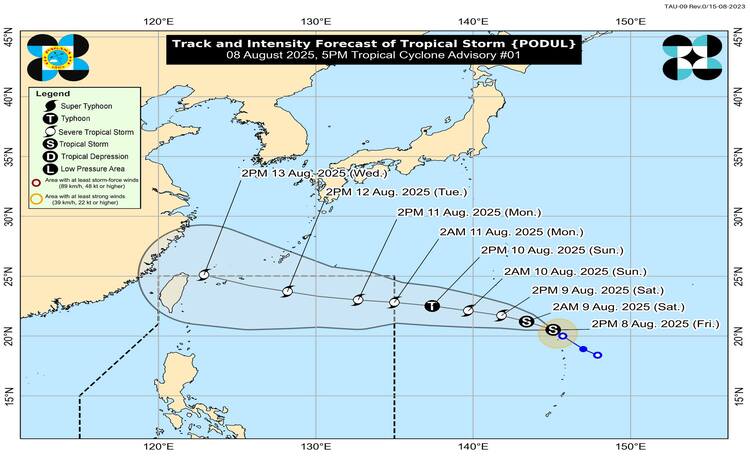
As of 4:00 PM today, the center of PODUL was located approximately 2,410 kilometers east of Extreme Northern Luzon (20.6°N, 145.0°E). The storm is packing maximum sustained winds of 75 km/h near the center and gustiness reaching up to 90 km/h, with a central pressure of 1000 hPa. PODUL is currently moving northwestward at a speed of 15 km/h.
PAGASA noted that strong to gale-force winds associated with the storm extend outward up to 180 kilometers from the center. Despite the size of the system, it is less likely to directly affect the Philippines within the next five days. However, close monitoring is advised as the system gradually intensifies.
According to the latest forecast, PODUL is expected to continue moving west-northwestward through Saturday, then shift westward by Sunday (August 10) through Tuesday (August 12). If this track continues, the tropical storm may enter the Philippine Area of Responsibility (PAR) between late Sunday evening and early Monday morning (August 11).
Meteorologists forecast that PODUL may strengthen into a severe tropical storm by Saturday afternoon, and further intensify into a typhoon by Sunday. However, PAGASA cautioned that the projected track and intensity from Monday to Wednesday (August 13) remain uncertain. A northward or southward deviation in PODUL’s path could significantly affect its development and potential impacts.
As of this advisory, no tropical cyclone wind signals have been raised in any part of the country.
Meanwhile, General Flood Advisories have been issued for parts of Eastern Visayas (Region 8) and the Bangsamoro Autonomous Region in Muslim Mindanao (BARMM), both under GFA #7 as of 6 PM today. These advisories are unrelated to PODUL but are in place due to localized rains possibly influenced by the Southwest Monsoon.